
Chapter IV
Your First Altar
Every spiritual practice begins with a sacred space. Your altar is a personal sanctuary, a place where the mundane meets the magical, where you can honor the elements, commune with the divine, and ground yourself in intention. It doesn't need to be elaborate. A windowsill, a corner of a desk, or a shelf will do. Anywhere you can return to with reverence becomes sacred.
Anatomy of a Beginner's Altar
Your altar is a sacred space and a physical reflection of your spiritual practice. There is no wrong way to build one. Start simple and let it grow with you.
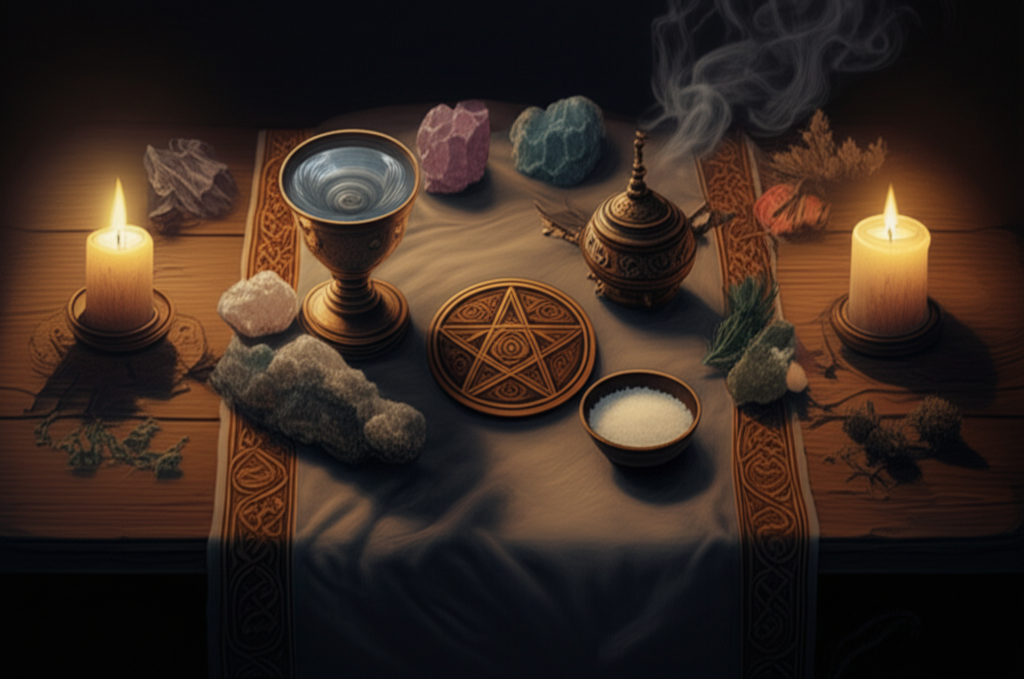
What Goes on an Altar
Each item on your altar carries meaning and purpose. Here are ten foundational pieces to consider as you build your sacred space. You do not need all of them. Start with what calls to you.
Candles
FireCandles represent illumination, transformation, and the fire element on your altar. They are one of the most fundamental tools in any pagan practice, used to focus intention and bring light to ritual work. A single white candle is the most versatile because it can stand in for any color or purpose. As your practice deepens, you may explore color correspondences: green for growth and abundance, red for passion and courage, blue for healing and peace, black for protection and banishing.
Getting Started
- Begin with a simple white taper or pillar candle, which works for any purpose
- Tea lights are an affordable and safe option, especially in small spaces
- LED candles are perfectly acceptable if you cannot have an open flame
- Never leave candles unattended; fire safety is part of responsible practice
Chalice or Bowl of Water
WaterThe chalice or bowl of water represents the element of water: emotions, intuition, the subconscious mind, and the flowing nature of life. Water on your altar connects you to the tides, the rain, the rivers, and the deep wells of inner knowing. It can be any cup or bowl that feels meaningful to you. Fill it with fresh water, moon water charged under a full moon, or ritual beverages used in ceremony.
Getting Started
- Any cup, goblet, or small bowl will work, and it does not need to be fancy
- Replace the water regularly to keep the energy fresh and clean
- Try making moon water by leaving a jar of water under the full moon overnight
- Place the chalice in the west quarter of your altar, the traditional direction of water
Incense or Feather
AirIncense and feathers both represent the element of air: thought, communication, intellect, and the breath of life itself. Burning incense carries prayers and intentions upward on its rising smoke, creating a bridge between the physical and spiritual realms. If smoke bothers you or you live in a space where you cannot burn incense, a feather serves beautifully as an air element representation, connecting you to the sky, to birds, and to the wind.
Getting Started
- Stick incense is the easiest to start with, and sandalwood and frankincense are classic choices
- A naturally found feather makes a wonderful and free altar tool
- Place your air representation in the east quarter of your altar
- If using loose incense, you will need charcoal discs and a heat-safe burner
Crystals and Stones
EarthCrystals and stones ground your practice in the earth element, carrying the ancient energy of the land itself. They have been used in spiritual practice across cultures for millennia. Clear quartz is the most versatile. It amplifies energy and can be programmed for any intention. Amethyst enhances intuition and spiritual connection, rose quartz opens the heart to love and compassion, and black tourmaline provides grounding and protection. Even a simple stone from your garden carries the power of the earth.
Getting Started
- Clear quartz is the best first crystal because it works for any purpose and amplifies other stones
- Stones you find in nature are just as powerful as polished crystals from a shop
- Cleanse your crystals regularly with moonlight, running water, or sound
- Place stones in the north quarter of your altar, the traditional direction of earth
Pentacle
Spirit / All ElementsThe pentacle (a five-pointed star enclosed in a circle) is one of the most recognized symbols in paganism. Its five points represent the five elements: earth, air, fire, water, and spirit, all held in balance within the encompassing circle of unity. It is a symbol of wholeness, protection, and the interconnectedness of all things. On your altar, the pentacle serves as a grounding focal point and can be used to consecrate other tools and offerings placed upon it.
Getting Started
- A pentacle can be drawn on paper, carved in wood, or purchased as a metal disc
- Place it at the center of your altar as a focal point and grounding symbol
- You can use it as a surface to consecrate and charge other altar items
- The point faces upward, representing spirit rising above the material elements
Athame or Wand
Varies by TraditionThe athame (a ritual knife, typically double-edged) and the wand are tools for directing energy during ritual work. The athame is never used for physical cutting. Instead, it is a symbolic tool that channels your will and intention, used to cast circles, invoke elements, and direct energy. The wand serves a similar purpose and is often preferred by those who are drawn to a gentler tool. In truth, your own finger, pointed with intention, works just as effectively as either tool.
Getting Started
- You do not need to buy a ritual knife, since a pointed finger works perfectly for directing energy
- A wand can be made from a fallen branch that speaks to you on a nature walk
- If using an athame, it should be dedicated solely to ritual use, never for mundane cutting
- Some traditions associate the athame with fire and the wand with air, while others reverse this
Offerings Bowl
DevotionAn offerings bowl is a dedicated vessel for leaving gifts to deities, ancestors, nature spirits, or the land itself. The act of offering is one of the oldest spiritual practices in human history, rooted in gratitude, reciprocity, and connection with the unseen. Offerings can be food, drink, flowers, coins, honey, herbs, or whatever feels right and meaningful to your practice. When you are finished, return food offerings to the earth by leaving them outside or composting them.
Getting Started
- Any small bowl or dish will work, though clay and ceramic feel especially grounding
- Fresh water is always an appropriate offering if you are unsure what to give
- Return food offerings to the earth rather than throwing them in the trash
- Research specific deity preferences if you are working with particular gods or goddesses
Deity Representations
SpiritIf your practice includes working with specific deities, you may wish to place representations of them on your altar. These can take many forms, such as statues and figurines, artwork and printed images, natural objects associated with a deity, or simply a candle dedicated to their honor. Deity representations are entirely optional. Many pagans work without specific deities, focusing instead on the elements, the earth, or the divine as they experience it. Let your practice guide you.
Getting Started
- A printed image in a small frame is an easy and affordable starting point
- Natural objects can represent deities, like an acorn for the Green Man or a shell for Aphrodite
- A dedicated candle in a color associated with your deity is a simple and powerful representation
- Take time to research and develop a genuine relationship before placing a deity on your altar
Altar Cloth
FoundationThe altar cloth serves both a practical and symbolic purpose. It sets your sacred space apart from the mundane surface beneath it, marking the boundary between the everyday and the magical. It can be any piece of fabric that feels meaningful to you. Many practitioners change their altar cloth with the seasons or sabbats, using colors that correspond to the turning of the Wheel of the Year. Natural fabrics like cotton, linen, and silk are traditionally preferred, but use what you have.
Getting Started
- A scarf, bandana, or piece of fabric from a craft store works perfectly
- Match colors to the season: white for winter, green for spring, gold for summer, orange for autumn
- Natural fabrics like cotton and linen are traditional, but any fabric is fine
- Wash or cleanse your altar cloth periodically to refresh the energy of your space
Personal Items
SelfYour altar should be a reflection of you and your unique spiritual journey. Personal items like photographs of loved ones or ancestors, family heirlooms, objects found on meaningful walks, artwork you have created, and written prayers or intentions all have a place on your altar. These items carry your personal energy and story, making your altar truly yours. There is no guidebook for this; if something holds spiritual significance for you, it belongs on your altar.
Getting Started
- A photo of an ancestor or loved one connects you to your lineage and their wisdom
- Objects found in nature (shells, feathers, acorns, interesting stones) carry the energy of the land
- Handwritten intentions or prayers add your own words and energy to the space
- Let your altar evolve over time as your practice grows and changes with you
There Is No Wrong Way
The most important thing about your altar is that it feels right to you. There are no rules that cannot be bent, no traditions so rigid that they cannot make room for your own intuition. Start with a single candle and a clear intention. Add items as they find you. Maybe it will be a stone from a riverbed, a feather on a forest path, or a gift from someone who matters.
Your altar is a living thing. It will change with the seasons, with the phases of the moon, with the unfolding of your own spiritual journey. Tend to it. Spend time at it. Let it be a place of peace, reflection, and power. The magic is not in the objects. It is in your presence and intention.