Chapter V
Sacred Symbols
From the pentacle to the triquetra, sacred symbols carry the distilled wisdom of countless generations. They are shorthand for the mysteries, with each line and curve holding layers of meaning across pagan traditions, connecting us to the divine, the elemental, and the eternal.
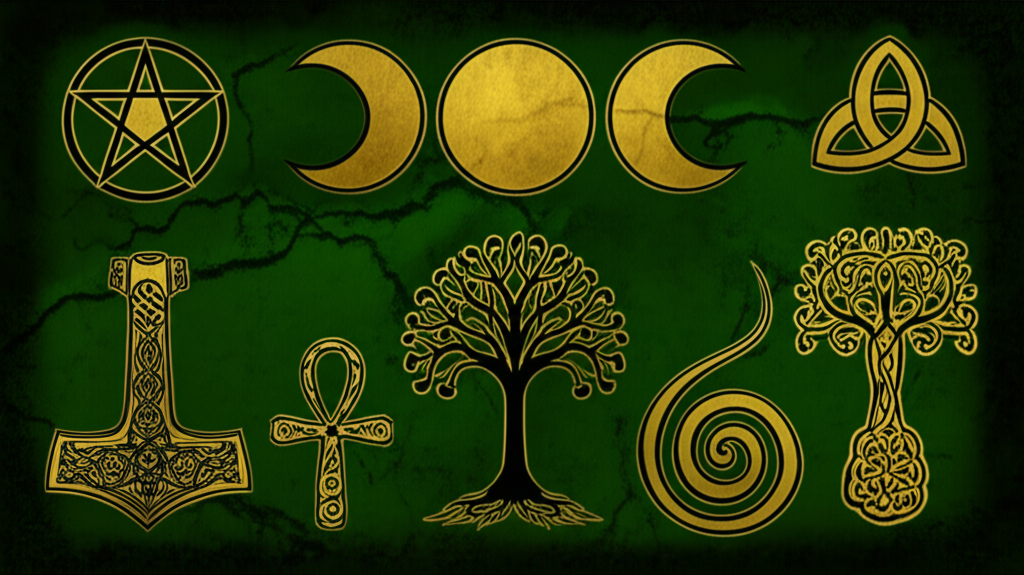
Twelve Sacred Symbols
The Pentacle
Also known as: Pentagram
The five-pointed star enclosed within a circle is perhaps the most recognized symbol in modern paganism. Each point represents one of the five elements (Earth, Air, Fire, Water, and Spirit), unified by the circle of wholeness. Upright, it symbolizes the triumph of spirit over matter, protection, and the balanced integration of all elemental forces.
Common Uses
- Worn as a pendant for spiritual protection and to identify one's path
- Drawn at the quarters during circle casting to invoke elemental energies
- Placed on the altar as a focal point for ritual work and offerings
- Used in banishing rituals to dispel negative energies from a space
Triple Moon
Also known as: Maiden, Mother, Crone
The Triple Moon depicts the waxing crescent, full moon, and waning crescent together, representing the three faces of the Goddess. It embodies the Maiden's new beginnings, the Mother's fullness of power, and the Crone's deep wisdom. This symbol honors the feminine divine and the eternal dance of the lunar cycle through all stages of life.
Common Uses
- Honored during esbats and full moon rituals to invoke the Goddess
- Worn to connect with the feminine divine and lunar energies
- Used to mark the phases of life in rites of passage ceremonies
- Inscribed on tools dedicated to moon magic and divination
Tree of Life
Also known as: World Tree, Crann Bethadh
Found in nearly every spiritual tradition across the globe, the Tree of Life symbolizes the interconnection of all living things. Its roots reach deep into the underworld, its trunk stands firm in the middle world, and its branches stretch toward the heavens. It represents growth, wisdom, ancestral connection, and the eternal cycle of renewal.
Common Uses
- Meditated upon to connect with ancestral wisdom and the spirit world
- Used as a focus for grounding exercises and earth-based rituals
- Depicted on altars to represent the three worlds and cosmic order
- Worn as a reminder of personal growth and spiritual evolution
Triquetra
Also known as: Celtic Trinity Knot, Celtic Knot
The Triquetra is formed by three interlocking arcs creating a continuous, unbroken line. This hallmark of Celtic knotwork symbolizes eternity. It represents the threefold nature of existence: maiden, mother, and crone; land, sea, and sky; past, present, and future. Its unbroken form speaks to the interconnectedness and eternal nature of these sacred triads.
Common Uses
- Used in Celtic-inspired rituals to invoke the power of three
- Worn as a symbol of the threefold Goddess or land, sea, and sky
- Inscribed on handfasting cords and wedding rings as a bond of eternity
- Placed on altars during seasonal celebrations honoring the Celtic traditions
Ankh
Also known as: Key of Life, Crux Ansata
The Ankh is one of ancient Egypt's most enduring symbols, representing eternal life and the union of the divine masculine and feminine. The loop suggests the rising sun on the horizon, while the cross beneath anchors it to the earthly plane. Egyptian deities are often depicted holding the Ankh, bestowing the gift of life upon pharaohs and devotees alike.
Common Uses
- Carried as a talisman for vitality, health, and spiritual longevity
- Used in Kemetic (Egyptian) pagan rituals to invoke divine blessing
- Placed on altars dedicated to Egyptian deities such as Isis and Osiris
- Meditated upon to explore the mysteries of life, death, and rebirth
Spiral / Triskelion
Also known as: Triple Spiral, Triskele
The Triskelion consists of three interlocking spirals radiating from a common center, representing the perpetual motion of life, death, and rebirth. Found carved into the ancient stones of Newgrange in Ireland, this symbol predates written history. It speaks to the cyclic nature of existence, the journey inward to self-knowledge, and the ever-expanding spiral of spiritual growth.
Common Uses
- Used in meditation to journey inward and explore past, present, and future
- Carved or drawn to honor the cycles of life, death, and rebirth
- Placed at sacred sites and altars during Celtic and Druidic ceremonies
- Worn to symbolize personal transformation and spiritual evolution
Horned God
Also known as: Cernunnos, Lord of the Wild
The Horned God symbol represents the masculine divine in nature, wild and untamed, deeply connected to the forest, the hunt, and the cycles of the sun. Often identified with Cernunnos in Celtic tradition and Pan in Greek lore, the Horned God embodies virility, death and resurrection, and the primal forces of the natural world across the turning year.
Common Uses
- Invoked during sabbats, especially Beltane and the winter solstice
- Placed on altars to honor the God alongside the Goddess
- Used in rites exploring the masculine divine and its relationship to nature
- Worn or drawn to connect with wild, untamed spiritual energies
Green Man
Also known as: Jack-in-the-Green, Foliate Head
The Green Man is an ancient archetype of the spirit of vegetation. Depicted as a face peering out from a mask of leaves, he represents nature's irrepressible vitality. Found carved in medieval churches and ancient temples alike, he embodies the cycle of growth each spring, the abundance of summer, and the promise that even after winter's death, green life will return anew.
Common Uses
- Honored at Beltane and during spring and summer celebrations
- Depicted on altars and in sacred spaces to invite nature's blessings
- Used in garden magic and rituals to encourage growth and abundance
- Meditated upon to connect with the spirit of the wild and the green world
Eye of Horus
Also known as: Wadjet Eye, Udjat
The Eye of Horus originates from the myth of the Egyptian falcon god whose eye was torn out in battle and magically restored, making it a potent symbol of healing, protection, and wholeness. Each part of the eye was also associated with a fraction, linking it to sacred mathematics. In pagan practice, it is invoked for psychic protection, clarity of vision, and spiritual healing.
Common Uses
- Worn or displayed as an amulet of protection against negative forces
- Used in healing rituals and spells for physical and spiritual restoration
- Placed near doorways or windows to guard the home
- Invoked during divination work to enhance psychic sight and clarity
Mjolnir
Also known as: Thor's Hammer
Mjolnir, the mighty hammer of the Norse god Thor, is one of the most recognizable symbols in Heathen and Norse pagan traditions. It represents divine strength, the defense of the sacred, and the power of the thunderstorm. In the Viking age, Mjolnir pendants were worn as a declaration of faith, much as others wore crosses, and the symbol was used to bless and consecrate.
Common Uses
- Worn as a pendant to declare one's Heathen or Norse pagan path
- Used to consecrate sacred spaces, objects, food, and drink in blot rituals
- Invoked for protection during travel and against spiritual harm
- Placed on altars dedicated to Thor and the Norse gods
Hecate's Wheel
Also known as: Strophalos of Hecate
Hecate's Wheel is a maze-like circular symbol associated with the Greek goddess of crossroads, magic, and the liminal spaces between worlds. The labyrinthine design represents the winding path of spiritual knowledge and the three-way crossroads where Hecate stands guard. It is a symbol of divine feminine power, witchcraft, and the ability to see past, present, and future simultaneously.
Common Uses
- Used in devotional practice and rituals honoring Hecate
- Placed at crossroads as offerings during dark moon rituals
- Meditated upon for guidance when facing difficult choices or transitions
- Inscribed on tools used in shadow work and necromantic practice
Sun Cross
Also known as: Solar Cross, Wheel Cross, Odin's Cross
The Sun Cross is one of humanity's oldest symbols: a simple equal-armed cross within a circle, found in rock carvings dating back thousands of years. It represents the sun, the four cardinal directions, the four elements, and the four solar festivals of the Wheel of the Year. It is a symbol of balance, wholeness, and the life-giving power of the sun that sustains all existence.
Common Uses
- Used during solar sabbats such as Litha and Yule to honor the sun
- Drawn to mark the four cardinal directions when casting a circle
- Placed on altars as a symbol of balance and the turning year
- Worn as a talisman for vitality, strength, and solar blessings