Chapter II
The Wheel of the Year
Eight sacred sabbats mark the turning of the seasons. Together they form a perpetual cycle of death and rebirth, darkness and light, rest and abundance. The Wheel has no beginning and no end, only the eternal dance of the earth around the sun.
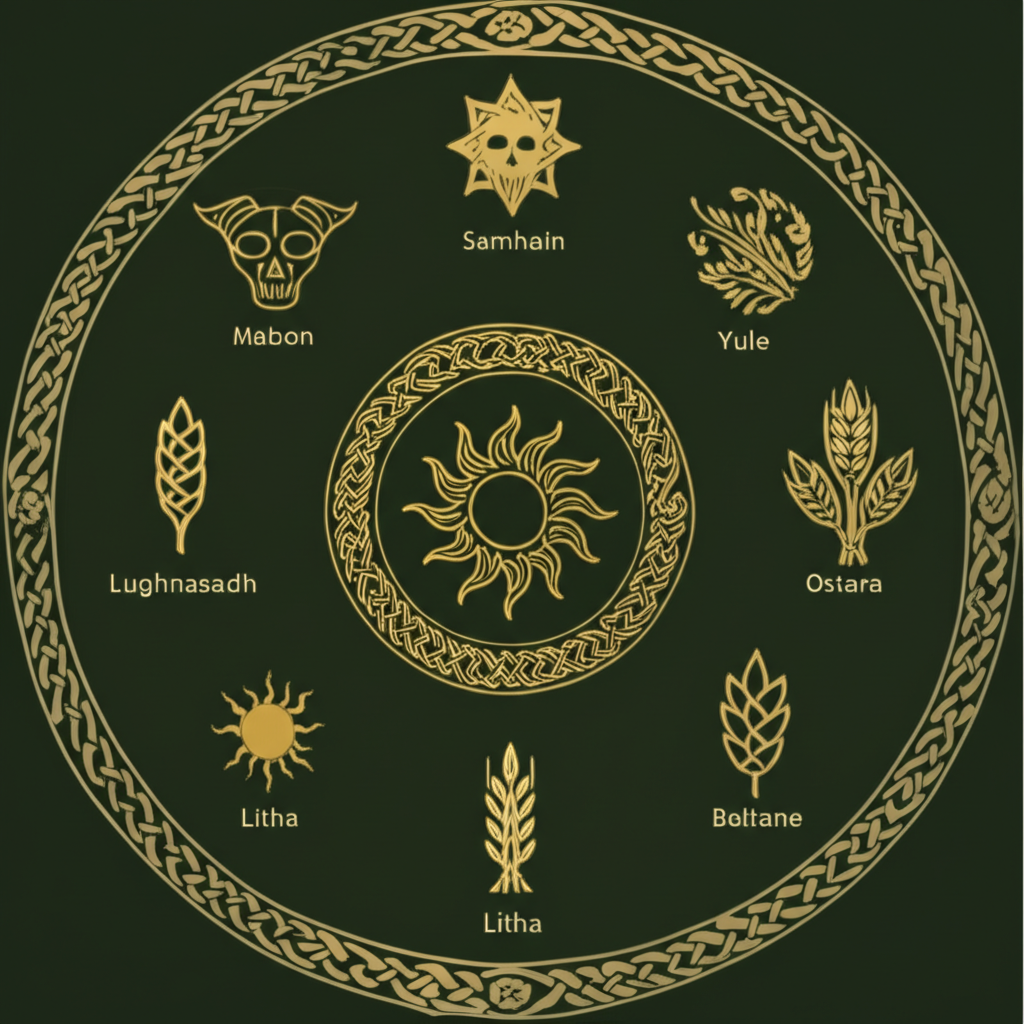
The Wheel of the Year is divided into eight sabbats: four solar festivals tied to the solstices and equinoxes, and four fire festivals that fall between them. Together they trace the arc of the God and Goddess through birth, courtship, union, harvest, death, and rebirth. Each sabbat is a doorway, an invitation to align your own inner rhythms with the great turning of the earth.
Samhain
(SAH-win)
October 31 – November 1
Samhain marks the pagan new year and the final harvest. It is a liminal night when the veil between the worlds of the living and the dead grows thin as gossamer. It is the most sacred and solemn of the sabbats, a time to honor ancestors, remember the beloved dead, and acknowledge the presence of the unseen. In the old Celtic calendar, this was the boundary between the light half and the dark half of the year, and bonfires blazed on hilltops to guide spirits and ward off malevolent forces.
Altars are set with photographs of those who have passed, plates of food left out as offerings, and candles lit in windows to welcome wandering souls home. Divination is especially potent at Samhain, and tarot, scrying, and spirit communication all carry a deeper clarity. Many practitioners hold a "Dumb Supper," a silent meal eaten in reverence, with a place set for the dead.
Samhain reminds us that death is not an ending but a turning. The fields lie fallow, the trees release their leaves, and the earth prepares for the long rest of winter. In that release, there is wisdom: we too must let go of what no longer serves us, honor what has passed, and trust in the darkness before the return of light.
Yule
(YOOL)
December 20 – 23 (Winter Solstice)
Yule celebrates the Winter Solstice, the longest night and the triumphant return of the sun. On this darkest of days, ancient peoples lit great fires and adorned their homes with evergreen boughs as a defiant promise: the light will return. The Goddess, having rested in the underworld, gives birth to the Sun Child, the young God who will grow stronger with each passing day until the wheel turns to summer once more.
The Yule log is among the oldest traditions: a great oak log, often inscribed with runes or wishes, burned through the night to symbolize the rekindling of the sun. Holly and ivy, mistletoe and pine, all carry deep meaning: they are the plants that refuse to die in winter, symbols of resilience and the undying green heart of the earth. Gift-giving at Yule predates Christianity by centuries, rooted in the spirit of generosity during the lean months.
This is a sabbat of hope in the midst of darkness, a reminder that even the longest night must yield to dawn. It is a time for family, warmth, candle lighting, and quiet reflection. Many pagans stay up through the solstice night in vigil, greeting the first rays of the reborn sun with song, prayer, and gratitude.
Imbolc
(IM-bulk)
February 1 – 2
Imbolc is the festival of first stirrings, the earliest whisper of spring beneath the frozen ground. The name likely derives from the Old Irish i mbolg, meaning "in the belly," a reference to the pregnant ewes who begin to lactate around this time. It is sacred to Brigid, the beloved Celtic goddess of poetry, healing, and smithcraft, whose triple flame illuminates the path from winter's darkness toward the growing light.
Candles are the heart of Imbolc. Every window is lit, every room brightened, to coax the sun's return and honor Brigid's sacred fire. Many practitioners craft Brigid's crosses from rushes or straw, an ancient protective symbol hung above doorways. This is also a powerful time for purification: spring cleaning of both home and spirit, cleansing rituals with salt and smoke, and the setting of intentions for the season of growth ahead.
Though the world still appears barren, Imbolc teaches us to look beneath the surface. Seeds are stirring in the dark earth. The days are perceptibly longer. The Goddess recovers from the birth of the Sun Child and walks the land as the Maiden once more, her footsteps coaxing snowdrops and crocuses from the soil. Imbolc is a sabbat of patience, hope, and the quiet certainty that spring will come.
Ostara
(oh-STAR-ah)
March 20 – 23 (Spring Equinox)
Ostara celebrates the Spring Equinox, that perfect, fleeting moment when day and night stand in equal balance before the light surges ahead. Named for the Germanic goddess Eostre (from whom we also get the word "Easter"), this sabbat is a celebration of fertility, renewal, and the unstoppable force of new life. The earth awakens in earnest: buds swell on branches, birds return from their winter journeys, and the air itself seems charged with possibility.
Eggs are the quintessential symbol of Ostara, representing potential, the cosmos, and the promise of new beginnings. Many pagans decorate eggs with magical symbols, bury them in gardens as fertility charms, or place them on altars alongside spring flowers. The hare, too, is sacred to this season. It is an ancient symbol of the Goddess associated with the moon, fertility, and the wild, untameable energy of spring.
Ostara is an ideal time for planting seeds, both literal and metaphorical. Whatever intentions you set at Imbolc can now be given form. Start new projects, plant your garden, begin a course of study, or take a first step toward a long-held dream. The equinox reminds us that balance is not a static state but a dynamic dance, an equilibrium between action and rest, giving and receiving, light and shadow.
Beltane
(BEL-tayn)
May 1
Beltane is the great fire festival of fertility, passion, and the triumphant arrival of summer. Falling opposite Samhain on the Wheel, it marks the boundary between the dark and light halves of the year. Like Samhain, it is a time when the veil between worlds grows thin, though here it is the realm of the fae that draws close. Ancient Celts drove cattle between two great bonfires for purification and protection, and lovers leapt the flames together to seal their bonds.
The Maypole is perhaps the most recognizable symbol of Beltane, a towering pole wreathed with ribbons around which dancers weave in joyful celebration of the sacred union between the God and Goddess. This union is the heart of Beltane: the young God, now grown to full strength, joins with the Maiden Goddess in the Great Rite, a divine marriage that ensures the fertility of the land. Flowers crown every head, garlands adorn every doorway, and the greenwood beckons.
Beltane is unabashedly sensual and joyous. It celebrates the body, desire, creativity, and the vital force that drives all life. This is a time to embrace pleasure without guilt, to dance barefoot in the grass, to weave flower crowns, and to honor the sacred within the physical. The earth is lush, the hawthorn blooms, and every living thing pulses with the energy of growth and desire.
Litha
(LITH-ah)
June 20 – 23 (Summer Solstice)
Litha, the Summer Solstice, is the crown of the year and the longest day, when the sun stands at its zenith and the world is drenched in golden light. This is the peak of the God's power, a day of triumph and abundance, yet it carries within it the bittersweet knowledge that from this point forward, the days will shorten and the wheel will turn toward darkness once more. In this paradox lies one of Litha's deepest teachings: at the height of power, the seeds of change are already sown.
Herbs gathered at midsummer are believed to be at the peak of their magical potency. St. John's Wort, lavender, mugwort, and vervain are traditionally harvested on this day and dried for use in healing, protection, and spellwork throughout the year. The fae are particularly active at Litha, and Shakespeare's A Midsummer Night's Dream captures something genuine about the folklore of this enchanted night, when the boundaries between the mortal world and faerie grow thin.
Bonfires blaze on hilltops at Litha, as they have since time beyond memory. Wheels of fire were rolled downhill to mimic the sun's journey across the sky. Today, pagans celebrate with outdoor feasts, flower garlands, sun wheels, and rituals of gratitude for the abundance of summer. It is a time to bask in the fullness of life, to celebrate achievements, and to gather the energy and magic that will sustain you through the darker months to come.
Lughnasadh
(LOO-nah-sah)
August 1
Lughnasadh (also known as Lammas, meaning "loaf mass") is the festival of the first grain harvest, a celebration of abundance, skill, and the sacrificial God. It is named for Lugh, the Celtic god of light, craft, and many talents, who established the festival in honor of his foster mother Tailtiu, who died from exhaustion after clearing the plains of Ireland for agriculture. In Lugh's grief and gratitude, we find the essence of this sabbat: the recognition that all abundance comes at a cost.
Bread is the sacred center of Lughnasadh. The first grain is cut, ground into flour, and baked into a ritual loaf that is shared among the community. This act of transformation, from seed to stalk to grain to bread, mirrors the great alchemical processes of nature and spirit. Many practitioners bake bread in the shape of the God, the wheat sheaf, or the sun, offering the first slice to the earth in thanks. Corn dollies are woven from the last sheaf and kept as protective talismans until the following year.
Lughnasadh also carries a theme of competition and games, honoring Lugh's mastery of every art. In ancient Ireland, the festival included athletic contests, horse races, poetry competitions, and craft fairs. Today, this translates into celebrating your own skills, sharing your talents, and expressing gratitude for the fruits of your labor. The God willingly gives his life force into the grain so that the people may live. This sacred exchange asks us to consider what we are willing to sacrifice for the good of the whole.
Mabon
(MAY-bon)
September 20 – 23 (Autumn Equinox)
Mabon marks the Autumn Equinox, the second point of perfect balance in the Wheel, when day and night stand equal before the darkness claims the greater share. It is the festival of the second harvest, sometimes called the "Pagan Thanksgiving," a time of deep gratitude for the abundance of the earth. The orchards hang heavy with apples, the grape harvest is underway, and the land blazes with the fiery colors of autumn's turning.
Named for Mabon ap Modron, a figure from Welsh mythology who was stolen from his mother as an infant and imprisoned in the Otherworld, this sabbat carries themes of descent, seeking, and the approach of the dark half of the year. The God's power wanes visibly; the Goddess shifts from Mother to Crone. Leaves fall, nights lengthen, and the wild geese fly south. There is a poignant beauty in Mabon: the last warm days, the smell of wood smoke on the air, the knowledge that winter approaches.
Mabon is a time for taking stock. What have you harvested this year, not only in your garden, but in your life? What goals have been met, what lessons learned? Give thanks for what you have gathered and prepare for the leaner times ahead. Share your abundance with others, preserve what you can, and begin the inward turn that Samhain will complete. The Wheel reminds us that every ending holds the seed of a new beginning, and every descent into darkness is also a journey toward wisdom.